

Organizations often treat high engagement as proof that a team is healthy. People care about the work and keep showing up, so leaders assume the team is fine. An engagement score can hide the strain underneath.
Nearly one in five respondents were highly engaged and also felt emotionally drained “often” or more. They had not checked out. They were committed and depleted at the same time.
were highly engaged and also felt emotionally drained “often” or more.
Motiro is a team-motivation platform built to make patterns like this visible. It draws on Self-Determination Theory (SDT), a leading scientific theory of human motivation. Teams across the Red Cross Red Crescent network use it.
From the Red Cross Red Crescent network to Geneva
Motiro’s collaboration with the Red Cross Red Crescent network began in 2019. The dataset presented in Geneva contained 19,949 responses from 52 countries and 527 teams, collected between 2020 and 2026.
- Responses
- 19,949
- Countries
- 52
- Teams
- 527
- Survey period
- 2020–2026
The cross-country evidence and national cases presented in Geneva came from a collaboration among Gabriel Pictet and Fred Fulton from the IFRC, Carine Fleury Bique of the Swiss Red Cross, Oleksii Cherednichenko of the Ukrainian Red Cross, Salam Salloum of the Lebanese Red Cross, Christina Kaparti of the Cyprus Red Cross, and Wladston Ferreira Filho of Code Energy, which develops Motiro.
Motiro’s approach grew from research Gaëlle Vareilles conducted during her doctorate, including a 2015 realist evaluation of Red Cross community health volunteers. Her work combined SDT with realist evaluation, a method that asks a practical question: what works, for whom, and under which conditions?
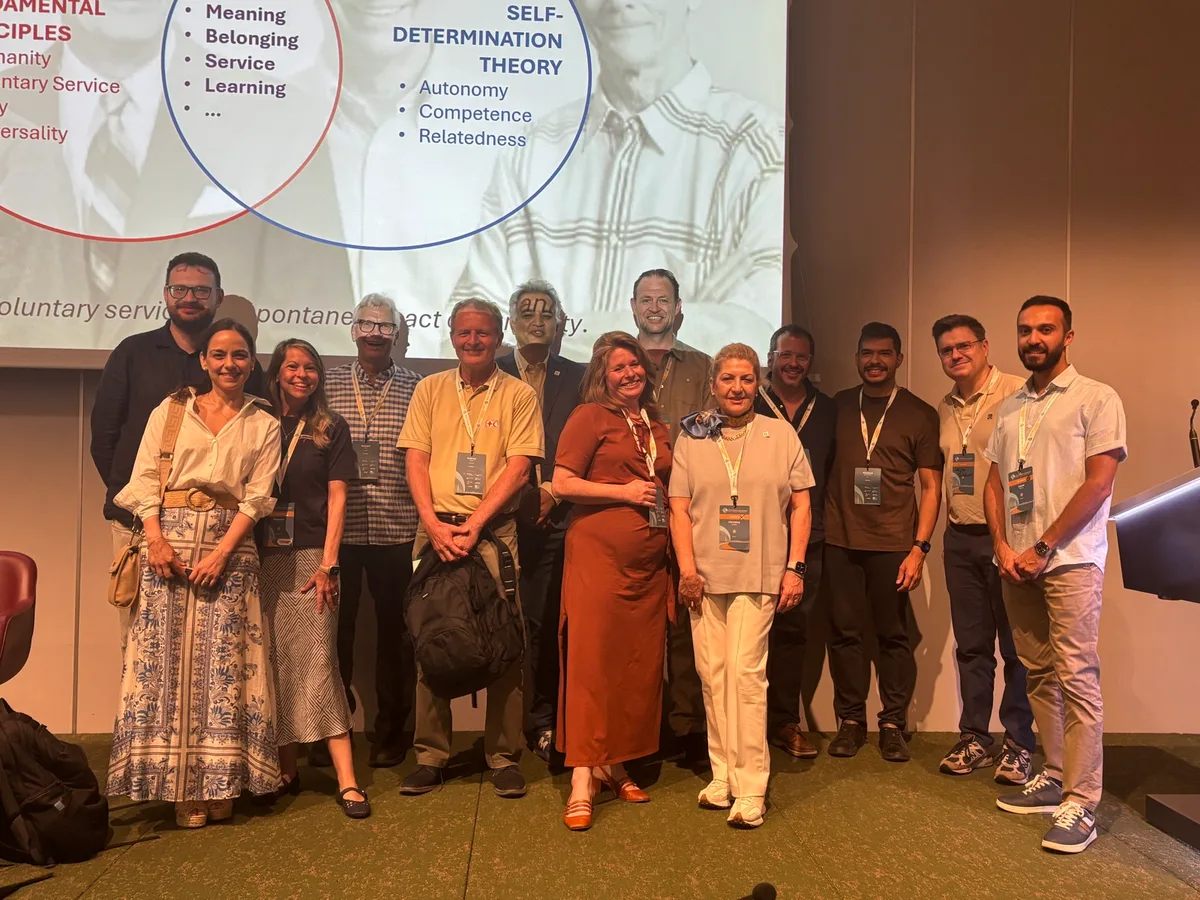
At the 2026 conference, a dedicated session brought together this cross-country study and case studies from Ukraine, Lebanon, Cyprus, and Switzerland. Julien Chanal, who heads the SDT Geneva Lab at the University of Geneva, chaired the session. We were honored that Richard Ryan, co-creator of SDT, attended the session.
Four findings from six years of evidence
1Why engagement can come at a cost
That committed-and-depleted pattern has an explanation many people will recognize. In workshops, volunteers and staff described staying engaged because they cared about the mission, their communities, or their colleagues—even as bureaucracy or scarce resources wore them down. The same engagement score can describe someone energized by the work or someone carrying that commitment at a personal cost.
2Belonging and meaning stood out
People bring three basic psychological needs to work. Autonomy is the experience of meaningful choice. Competence is the sense of being capable and able to grow. Belonging is the feeling of being cared for and connected. SDT uses these three needs to explain how social environments shape motivation. Across the dataset, all three were associated with stronger engagement, a greater intention to stay, and better well-being.
- Autonomy
- Meaningful choice
- Competence
- Feeling capable and able to grow
- Belonging
- Feeling cared for and connected
Belonging showed the strongest simple relationship with engagement. Autonomy was more closely related than the other two needs to intention to stay and well-being. These are associations from the same survey, not proof that one need causes an outcome or matters most in every context. What stood out was not a clean hierarchy among the three needs, but how closely they moved together.
When considered alongside the other measures, personal meaning was most closely associated with whether people intended to stay. Field discussions suggested that values alignment often meant more than agreeing with humanitarian principles. It also reflected whether people believed their organization acted fairly and lived those principles.
3Everyday leadership tracks motivation more closely than organizational management
These needs and values do not remain abstract; people experience them in everyday interactions. Respondents who felt listened to and supported by their supervisors also reported greater satisfaction of all three needs, along with stronger engagement and greater well-being.
The association with day-to-day leadership was stronger than the association with broader management practices such as recognition, communication, learning opportunities, and support structures. Each person rated both their leadership experience and their motivation in the same survey, so the study cannot establish which influenced the other.
The three needs above, placed in their everyday context
- Autonomy
- Competence
- Belonging
4Teams differed more than countries
The importance of the immediate environment also appeared at the team level. Teams in the same country could have substantially different motivational environments. An organization-wide dashboard can smooth those differences into a number that describes no team particularly well.
varied more than countries across every measure we compared.
Managers cannot change every source of individual variation, but they can examine the conditions inside their own team and act there.
How far these findings go
What remained consistent
The evidence presented in Geneva draws on one of the largest known SDT-based volunteer datasets in the humanitarian sector. That dataset was built from surveys that Red Cross Red Crescent teams conducted through Motiro. Across very different operating environments, satisfaction of the three needs remained closely associated with engagement, intention to stay, and well-being.
Across 1,504 responses from paid staff, the same broad relationships appeared despite some differences in average scores. The patterns were not limited to unpaid roles.
People describing motivation in interviews, workshops, and implementation reports repeatedly returned to trust, belonging, and everyday leadership. The same themes appeared in the survey results.
Where the boundary lies
The study captured a snapshot rather than change over time, and it relied largely on self-reports. It can show associations, but not whether Motiro improved later outcomes. The interviews, workshops, and reports came from the same initiative, so they add context rather than independent validation.
Why Motiro is designed around teams
Within those limits, Motiro follows a clear design principle: motivation is relational and local. Its aim is to scale learning rather than solutions—to give teams a shared process without forcing every team toward the same answer.
Motiro keeps individual answers private and presents protected, combined results for the team. Those results separate engagement, well-being, the three needs, leadership, and the work environment. A team can see both whether strain exists and where to investigate it.
Well-being
How do we really feel?

A Motiro cycle begins with a 27-question survey, normally open for 30 days. It is designed to carry teams from shared results to local action, then back to measurement.
- 1MeasureStart here
- 2Interpret together
- 3Choose locally
- 4Act
Motiro standardizes the evidence, not the answer. It handles measurement and analysis. Local practitioners supply context, facilitate discussion, and decide what follows.
What this means for other organizations
Measure well-being beside engagement. Interpret results at the team level. Examine belonging, lived values, and everyday leadership.
A final reflection
After years of measuring autonomy, competence, and belonging, members of the research collaboration unexpectedly found themselves becoming “more autonomous, more competent, and better friends.”
If motivation lives in a team’s everyday relationships, what might your teams reveal that organization-wide numbers cannot?